


From Legacy to Legendary: Modernizing Homegrown Customer Experience Platform for A Global Technology Firm
Client Overview
The client is a globally recognized leader in management, strategy, and technology solutions, offering expertise in operations, analytics, mergers and acquisitions, private equity, sustainability, marketing strategy, and more. As a pioneer in customer experience (CX), the firm empowers businesses to craft transformative customer journeys through its proprietary CX benchmarking platform.

Bottlenecks & Breakdowns: What Stood in the Way of a ScalableCX Solution?
Customer Experience (CX) has become a pivotal force driving sales, loyalty, and employee engagement, with global C-Suite executives now viewing it as their top growth strategy. However, the client was facing significant challenges in its efforts to enhance customer experience.
Slow & Cumbersome Client Onboarding
Manual data retrieval from online survey platforms extended the time required to set up and onboard new clients, delaying their CX transformation journey.
Inefficient Data Processing & Quality Management
The custom data engineering code, combined with the absence of standardized business logic implementation and a lack of a consistent approach to handling data quality errors, led to longer turnaround times for generating curated data.
Lagging Tableau Performance
Reading massive flat files strained Tableau’s efficiency, resulting in sluggish dashboard performance and sub-optimal data visualization experiences.
Solving Data and CX Challenges with a Strategic Approach Them
Indium thoroughly analyzed the client’s CX Benchmarking platform and identified key data processing, retrieval, and integration challenges. With a deep understanding of the issues, we recommended and implemented a robust, AWS-based solution to automate and optimize the entire data flow for seamless operations.
01
A Powerful AWS-Based Data Lake Solution
Assessed the client’s CX Benchmarking platform and business hurdles, recommending an AWS-based data lake analytics platform. This transformation automated data retrieval via Tableau dashboards and optimized the data flow using Alteryx for ETL processes.
02
Automating Data Retrieval with Python APIs
Automated the extraction from the Qualtrics online survey platform using custom Python APIs to streamline the data flow. The extracted data was saved into flat files, ready to be processed by Alteryx.
03
Migrating Historical Data for Future Efficiency
Using Alteryx ETL pipelines, a one-time migration of historical online survey data for US clients ensured the foundation for future scalability.
04
Turbocharging Data Processing with Alteryx ETL Pipelines
Built efficient Alteryx ETL pipelines to process the flat files and ingest the results directly into AWS S3. By harnessing Alteryx's parallel processing engine, the team significantly sped up data loading times.
05
Ensuring Seamless Integration with Tableau
Additional business logic was applied, and the refined data was loaded back into the presentation layer in AWS RDS for downstream consumption by Tableau dashboards.
06
Validating Accuracy & Repaving Tableau Dashboards
The final step involved repointing the Tableau dashboards to the AWS RDS and rigorously validating the results to ensure that the new data platform delivered accurate, real-time insights with no disruption to the existing workflows.
07
Designing a Flexible, Scalable Data Model
Implemented a generic dimensional data model in AWS RDS (PostgreSQL) that offered schema flexibility to accommodate taxonomies. This model minimized changes when onboarding new clients or instruments, while the slowly changing dimension (SCD) tracks changes.
08
Applying Instrument-Specific Business Logic
Alteryx ETL pipelines were used to pull data from the AWS S3 bucket, apply instrument-specific business logic, and store the results in AWS RDS. This ensured that data was tailored to meet the client’s specific needs.
Reinventing CX with Data That Moves at Lightning Speed
Accelerated Client Onboarding – 2x Faster:
By automating data retrieval and implementing a flexible data model, client onboarding time was reduced by 50%, speeding up the entire process.
5x Performance Boost in Tableau Dashboards
With pre-aggregated data stored in the presentation layer of AWS RDS, Tableau dashboard performance saw remarkable improvements, delivering faster insights.
Early Data Quality Error Detection
The dimensional data model, paired with reference/lookup tables and faster dashboards, enabled quicker identification of data quality errors early in the process, ensuring more accurate results.
Simplified Historical Data Validation
The flexible, generic data model allowed easy tracking of product/provider changes over time, significantly reducing the effort required for historical data validation.
Zero Data Loss – Reliable & Resilient Data Storage
The cloud-based data lake analytics platform, with its fault-tolerant architecture, ensured zero loss of online survey data, maintaining data integrity at all times.
We Built a Faster Claims Process With AI-Led Automation
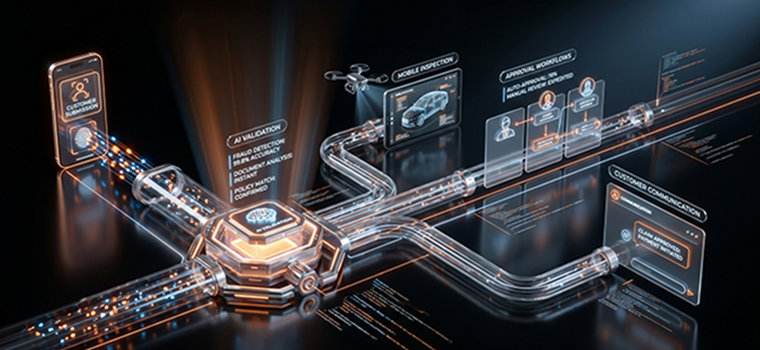
Using .NET, Angular, and React Native, Indium digitized key parts of the claims process through AI/ML automation solutions. It helped connect claims operations into an easier-to-manage process.
01
AI-Enabled Claims Dispatch
Automated claims dispatch workflows helped reduce dependency on manual coordination and improved how claims moved between operational teams.
02
Mobile Inspection Workflows
A mobile-friendly application enabled field inspectors to assess damage and update inspection details directly from the field.
03
Dedicated Insured Portal
A dedicated customer portal gave insured customers better visibility into claim progress and communication updates.
We Built a Faster Claims Process With AI-Led Automation
Using .NET, Angular, and React Native, Indium digitized key parts of the claims process through AI/ML automation solutions. It helped connect claims operations into an easier-to-manage process.

01
AI-Enabled Claims Dispatch
Automated claims dispatch workflows helped reduce dependency on manual coordination and improved how claims moved between operational teams.
02
Mobile Inspection Workflows
A mobile-friendly application enabled field inspectors to assess damage and update inspection details directly from the field.
03
Dedicated Insured Portal
A dedicated customer portal gave insured customers better visibility into claim progress and communication updates.
04
Digitized Claims Operations
Key parts of the claims process were digitized to reduce document-heavy workflows and improve operational coordination.
Results Achieved Through the New Claims Workflow
The implementation improved day-to-day claims operations through automated dispatch workflows and faster coordination between teams. The client could respond faster and manage claim movement with less operational effort.
01
100% Automated Claims Dispatch
Claims dispatch activities moved through an automated workflow and reduced dependency on manual coordination and repetitive operational follow-ups.
02
Automatic Claim Triggering
Claims management and inspection activities were automatically triggered based on workflow progression. This helped operational teams move claims forward faster.
03
Reduced Manual Work
Digitized workflows reduced dependency on scattered documentation and manual coordination between operational teams.
04
Faster Coordination
Operational teams could access inspection updates and claim movement information faster throughout the workflow.
Claims Teams Got Out of Coordination Mode
The client now manages claims operations through a more connected workflow across dispatch, inspections, and customer communication activities. Their teams spend less time coordinating updates manually and more time keeping claims moving through the process.
The new setup gives insured customers better visibility into claim progress and helps the client manage claims operations more consistently throughout the process.
Claims dispatch activities moved through an automated workflow and reduced dependency on manual coordination and repetitive operational follow-ups.