
Turning Digital FNOL Conversations into Actionable Claims
- November 25, 2026
- Posted by: Muthu Kumar Dev
- Category: Insurance

One of the key challenges in claims handling is getting the right information from the policyholder reporting the loss and capturing it accurately for the claims team.
Conversational AI can make digital First Notice of Loss (FNOL) more responsive by adapting questions to customer responses and ensuring the information collected is ready for further processing. The value of digital FNOL lies in connecting the conversation to the actions required to move a claim forward.
Where Do Digital FNOL Processes Fall Short?
First Notice of Loss (FNOL) marks the beginning of the insurance claims journey. Digital forms and rigid question flows may not adapt to individual circumstances. This can create several challenges for policyholders and claims teams:
- Incomplete information: Customers may omit important details or provide unclear answers.
- Limited guidance: Customers may struggle to understand which information is required or what supporting details they need to provide.
- Repeated interactions: Repetitive questions and lengthy conversations can cause frustration.
- Missed emotional cues: Chatbots may fail to recognize when a customer is distressed or needs additional assistance.
- Unverified backend actions: A chatbot may communicate naturally without confirming whether the requested action was completed in the connected system.
The opportunity is to move beyond digital submission towards a guided, responsive experience that understands the context, helps customers provide the right information at the right time, and connects the conversation to the next operational step.
Conversational AI in the Insurance Claims Process
Conversational AI in insurance allows FNOL interactions to adapt to customer responses instead of relying entirely on fixed question flows. It can ask relevant follow-up questions based on the information provided to capture incident details and identify gaps that require clarification.
As conversational AI and AI-enabled claims intake become established market directions, the focus shifts to how effectively these systems adapt to customer needs, preserve context, and coordinate the activities required to prepare a claim for further processing.
Make your insurance operations more responsive with AI
What Makes Conversational FNOL Effective?
The effectiveness of a conversational interface depends on how well it understands customer responses, validates information, recognizes when assistance is needed, and connects conversations to claims operations. This depends on a few key factors:
- Context-Aware Questioning: Conversations should adapt to information already provided, clarify ambiguous responses, and avoid unnecessary repetition.
- Information Validation: Customer, policy, and coverage information should be validated at the appropriate stage of intake.
- Guided Evidence Collection: Customers should receive guidance on supporting evidence and outstanding requirements.
- Emotional Awareness: The system should recognize potential signs of frustration, distress, dissatisfaction, or urgency and interpret these signals alongside incident circumstances, customer needs, available policy and claim information, business rules, and specialist-routing criteria. Sentiment analysis should inform decisions rather than independently determine routing, claim eligibility, or fraud outcomes.
- Contextual Human Handoff: Receiving representatives should have access to conversation history, information already captured, and the reason for escalation. Customers should also be able to request human assistance directly.
- Connected Execution and Backend Verification: The workflow should verify the connected system’s response and distinguish completed actions from pending requests, failures, or cases requiring review. A conversational response should not be treated as proof of successful execution.
Intelligent FNOL: A Multi-Agent Approach
Intelligent FNOL makes the loss reporting process more responsive through conversational AI. Indium’s proposed approach brings together six specialized agents and connected insurance systems to manage the FNOL workflow.
Each agent handles a specific task, from customer interaction to claim registration.
- FNOL Intake Agent
Engages customers through supported channels such as voice, web, mobile, or messaging. It captures the reason for reporting a loss, maintains conversation context, and guides customers through relevant questions based on their responses.
- Customer, Policy and Coverage Validation Agent
Checks available customer and policy information through authorized integrations. It validates relevant coverage details against available policy data and configured business rules, identifying missing or inconsistent information for clarification or review.
- Incident and Third-Party Information Capture Agent
Captures incident details, including when and where the loss occurred, the circumstances surrounding it, affected property or vehicles, injuries, and information about other involved parties. Follow-up questions adapt to the claim scenario and information already provided.
- Evidence and Documentation Analysis Agent
Guides customers through submitting supporting documents and images. It processes the submitted evidence to identify missing or unreadable information and compares available images with the incident description to flag potential inconsistencies for further investigation.
- Claim Summary and Risk Assessment Agent
Consolidates collected information into a structured claim summary and identifies missing mandatory details required for claim registration. It also flags potential anomalies, such as inconsistencies between incident descriptions and submitted evidence, for claims adjusters to investigate. These flags require further review and do not establish fraud.
- Claim Creation and Notification Agent
Supports claim registration through authorized system integrations once the required checks are satisfied. It verifies the connected claims system’s response to distinguish between a successfully registered claim, a pending request, and a failed submission. Relevant notifications are triggered based on the confirmed outcome.
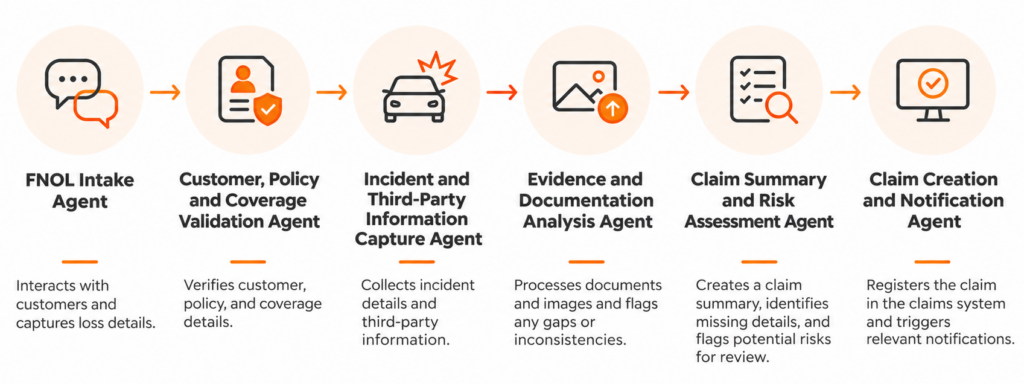
The orchestration layer coordinates task execution across the FNOL workflow. During human handoff, it shares the conversation history, captured information, and reason for escalation with the receiving representative.
Customers can request human assistance at any point, maintaining continuity between automated intake and human support.
The Impact of Intelligent FNOL on Claims Intake
The effectiveness of Intelligent FNOL can be assessed through measurable operational indicators.
- Intake completeness and evidence readiness: Measures whether required claim details are captured and supporting documents are available and usable for further processing.
- Repeat-contact rates and manual rework: Helps assess the effort involved in completing claims intake.
- Successful claim registration and escalation quality: Provides insight into workflow performance and the effectiveness of human handoffs.
These measures help insurers assess whether conversational FNOL improves the quality of information entering the claims process and reduces the effort required to prepare claims for further handling.
The First Conversation Sets the Course for Claims
The next stage of FNOL calls for a guided conversation that responds to customer circumstances and uses sentiment analysis to recognize potential signs of distress or frustration. The focus is on collecting reliable information and coordinating the steps required to prepare a claim for further processing.
Intelligent FNOL brings this approach to automated insurance claims through conversational AI, specialized agents, connected insurance systems, and human support when needed. The goal is to give claims teams accurate and complete information from the initial FNOL interaction.
Connect conversational AI with claims operations
