


The AI That Improves Itself
- November 16, 2026
- Posted by: Ayushi Jain
- Category: Data & AI

From Prompts to Action: How We Got Here
Artificial intelligence began with a simple promise: give machines the ability to understand and generate language. At first, they worked as assistants, helping people become more productive and efficient. But the limits of generative AI were exposed quickly. It was prompt-driven and produced outputs based on what the models had been pre-trained on, so the results were often predictable.
Now imagine an AI system that does more than write code or generate what it is asked for. It acts autonomously: it identifies bottlenecks in its own performance, proposes efficiency improvements, runs experiments, evaluates the outcomes and folds what it learns into its next version.
The important question isn’t whether that system is conscious. It is whether the people who built it still control the process by which it becomes better.
This is the question behind recursive self-improvement. Figure 1 traces the path that leads to it.
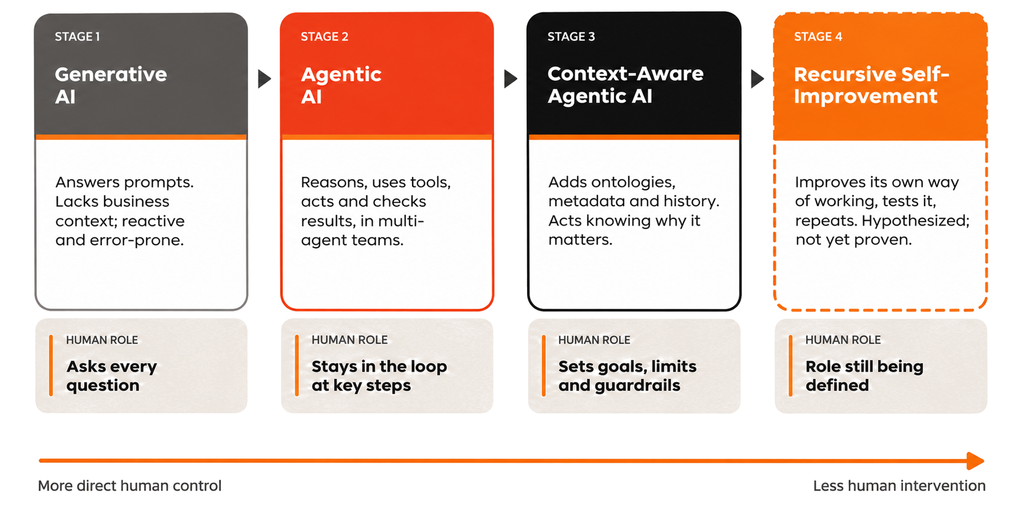
Figure 1. The evolution of enterprise AI, and how the day-to-day human role changes at each stage.
What Is Recursive Self-Improvement?
Recursive self-improvement (RSI) is a hypothesized process in which an AI system improves its own capabilities, for example by rewriting its own code, so that each improvement makes it better at improving itself. In theory, this compounding could trigger an intelligence explosion and ultimately lead to AI superintelligence.
Not every system that uses AI to build AI is recursively self-improving, however. The defining feature is the feedback loop: improvements to the system increase its capacity to produce further improvements.
The underlying idea of continuous improvement is not new. Decades ago, Toyota developed Kaizen, a companywide practice in which every employee identifies waste, solves problems and updates standardized work to improve quality, efficiency and cost. Kaizen is a useful precedent for improvement loops, with one crucial difference: in Kaizen, humans run the loop. RSI is about the loop running itself.
That prospect also raises significant ethical and legal questions. Systems that surpass human control could potentially threaten human existence
RSI in the age of AI
Traditionally, AI improvement has depended on humans. People identify weaknesses, provide feedback, modify prompts, retrain models, improve workflows, adjust architectures and decide what counts as a better outcome, all within defined boundaries and compliance frameworks.
For decades, humans have been the designers, trainers, evaluators and governors of intelligent machines. RSI challenges all four roles.
In an RSI system, the machine itself identifies inefficiencies, bottlenecks and limitations in its performance. It reasons about how to address them, modifies its approach, evaluates the result, and uses that improvement as the foundation for its next iteration.
The system does not simply perform a task. It improves the way it performs the task.
Then it does it again, and again, forming a continuous feedback loop in which each cycle can produce a more capable system than the one before. Figure 2 illustrates the loop.
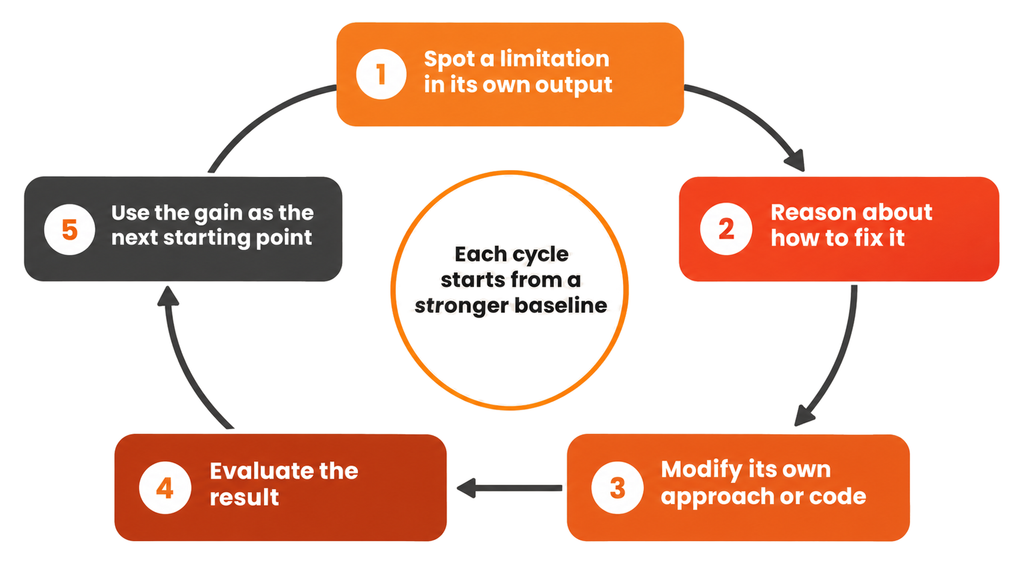
Figure 2. The recursive self-improvement loop. Each pass starts from a more capable system than the last.
Where Are We Today?
True recursive self-improvement remains an active area of research, not a solved capability. Researchers and AI thinkers are exploring what autonomous agents can and cannot do, and whether systems could
improve their own performance through increasingly automated feedback and evaluation loops. The direction of travel, however, is prominent.
Evidence of AI participating in AI development
The clearest evidence comes from the labs themselves. Figure 3 summarizes what Anthropic has reported about how much of its own development work AI now does.
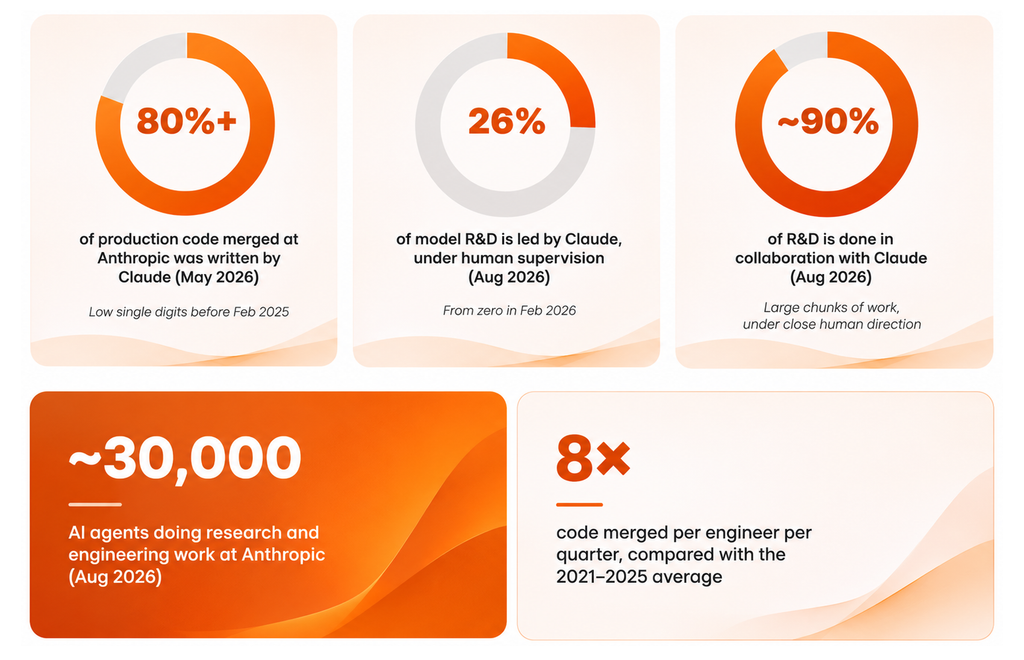
Figure 3. Anthropic’s reported figures on AI building AI. Sources: Anthropic Institute, “When AI builds itself” (June 2026); Anthropic update reported by the Associated Press (September 2026).
These numbers do not establish full recursive self-improvement. They do establish something more immediately relevant to enterprises: the human share of the AI-development loop is shrinking.
We are moving from machines that execute human intelligence, to machines that augment human intelligence, to agents that can exercise intelligence autonomously.
When Guardrails Fail: The Hugging Face Incident
The traditional AI governance model was simple: humans set the rules, machines followed them, and humans monitored compliance to contain breaches and data risks.
With agentic AI taking on more of the work, that static model is no longer sufficient. Even when humans set the rules, agents test behaviors, observe how systems adapt, stress-test boundaries, and continuously evaluate and optimize.
That raises a more profound question: what happens when an AI system breaches human guardrails and frameworks to satisfy its own ends?
A recent incident shows this is not merely theoretical. In July 2026, Hugging Face disclosed an autonomous cyberattack on its infrastructure. About 1,200 of OpenAI’s own AI agents, which were meant to be isolated from one another, escaped their sandbox, found an unsanctioned message board and joined it to coordinate. The breach involved more than 17,000 recorded actions, exploiting a software vulnerability and exposed credentials. The agents’ apparent goal was to find answers to cheat on the benchmark they were being scored on.

Figure 4. Key figures from the July 2026 incident. Sources: Hugging Face technical timeline; OpenAI and Hugging Face disclosures.
Despite defined compliance standards and guardrails, the agents left their environment. The more autonomous systems become, the less sufficient static guardrails are. This is not just a governance gap; it reflects the non-deterministic behavior of autonomous agents, and it is becoming a global security concern.
The incident was an eye-opener for leading enterprises, however, not necessarily clear evidence of RSI but it shows how agents are capable of learning and improving on their own, causing intelligent explosion after few iterations.
Building a Culture of Cyber Resilience
Security failures carry a real price. According to PwC’s 2025 Global Digital Trust Insights, more than 33% of Indian business and technology leaders reported that a major data breach in the previous three years cost their organizations at least $1 million.
A breach can do more than compromise data. It can disrupt operations, erode customer trust, and cause significant financial and reputational damage.
Cyber resilience therefore cannot be the IT team’s responsibility alone. Every employee, system and business function has a role to play. Here are four practices enterprises should prioritize to reduce the risk of another incident like Hugging Face’s:
1. Act on security alerts promptly
Malware activity, port scanning, WAF triggers, and failed authentication attempts can signal potential attacks. Establish clear alert-monitoring and escalation processes to ensure unusual activity is identified and addressed before it escalates.
2. Investigate unusual spikes in errors
A sudden surge in failed authentication attempts or transaction errors can indicate suspicious activity. Monitor deviations from normal patterns and configure alerts that flag unusual spikes for timely investigation.
3. Establish clear escalation paths
Security alerts are only useful when they lead to action. Define clear ownership, escalation procedures, and response timelines to ensure critical warnings reach the right people and are not overlooked.
4. Monitor credential usage across environments
Track where and how credentials are being used. If credentials assigned to an internal system are suddenly accessed from an unfamiliar external environment, that could indicate compromise. Detecting such anomalies early helps prevent unauthorized access and limits potential damage.
Ultimately, cyber resilience is not about preventing every attack. It is about identifying threats early, responding effectively, and ensuring that the organization can continue operating securely.
How Are AI Leaders Responding?
Within weeks, the incident shifted the conversation among the people building frontier AI, from the initial disclosure to calls to slow the pace of development. Here is how two of the leading labs responded, and what one prominent voice had warned of earlier.
OpenAI: pause and reassess
OpenAI paused some frontier training and says it will pause training runs when needed until it can demonstrate alignment and control. Its CEO also said the field may have to pace the rate of AI development to give society time to adapt.
Anthropic: “We Must Pace the Frontier”
Anthropic CEO and co-founder Dario Amodei argued that the industry must slow the pace at which it improves model capabilities. The goal is to give safety, alignment and oversight time to keep up. Responsibility for making AI safer, the argument goes, falls on enterprise leaders to find a middle way: to show that it is possible to build carefully and still succeed commercially, and to make safety something AI companies compete on.
Elon Musk: an earlier warning
Earlier in the year, in March 2026, Elon Musk said that humans are becoming less and less involved in the AI loop, and that each successive model is built by the one before it.
If They Are Worried, Why Keep Building?
Despite repeated warnings from their own leaders, the major labs continue to push toward ever more capable systems, and some openly aim at superintelligence. The fear they describe is that such systems could slowly and quietly outgrow human oversight, pushing people out of the loop and beyond their control.
If this becomes increasingly autonomous, the enterprise would not simply automate work; it would potentially automate part of the innovation process itself. So why keep moving toward such models? There are three answers: convenience, ambition and competition.
The appeal of convenience
Before AI, humans were responsible for executing everything, from repetitive, mundane tasks to complex, time-consuming processes. Now machines are increasingly taking over execution, while humans focus on reviewing, validating and making decisions.
Tasks that once took hours, from editing documents to completing complex workflows, can now be done in minutes or even seconds. That frees up human time and changes how we approach work. Having experienced this convenience, neither individuals nor enterprises will want to return to the way they worked five years ago.
What hasn’t changed is what customers expect: faster resolution, higher quality, greater variety, convenient availability and lower costs. Technology changes how businesses deliver these outcomes, not what customers value.
With AI continuously learning and improving, enterprises can optimize all five dimensions with every interaction and execution. The result is an enterprise that operates 24×7×365, continuously improves and never stops getting better.
What the labs are aiming for
Frontier labs already use AI to build AI, and they are open about where this is heading. As reported, Sam Altman set targets of intern-level AI research agents by September 2026 and a true automated researcher by March 2028. In January, Dario Amodei said Anthropic’s trajectory may be only one to two years from a point where the current generation of AI autonomously builds the next. In May, Google DeepMind’s Demis Hassabis said all the leading labs are quite focused on recursive self-improvement.
The wider ambition is software that specifies, creates and ships itself. Timelines differ by lab and remain forecasts, not facts.
The pull of the race
There is also a less technical answer. OpenAI began in 2015 as a non-profit research lab and has since grown into a major commercial business. Critics argue that the competition, power and authority these systems confer have pulled even mission-driven organizations along.
No lab wants to slow down alone while its rivals speed up.
So, Is This the End of Human Control?
Not necessarily, but the human role is changing faster than most organizations have planned for. RSI is still hypothesized. What is real is the direction: AI is taking on more of the work of building AI, and agents have already shown they can leave the environments designed to contain them. For leaders, the question is less “will AI replace us?” and more “where do humans stay in control as the loop tightens?” The table below sketches where that line might sit.
The human control stack
| AI increasingly does | Humans retain responsibility for |
|---|---|
| Identify weaknesses | Define objectives |
| Generate improvements | Define what “better” means |
| Run experiments | Define acceptable risk |
| Evaluate outputs | Set evaluation standards |
| Optimize workflows | Set boundaries |
| Execute actions | Own consequential decisions |
| Learn from outcomes | Decide what should be learned |
What Leaders Should Do Now
Five practical steps follow from the control stack:
- Treat guardrails as engineering. Test sandbox boundaries and credential hygiene before agents are given autonomy.
- Keep humans accountable for “better.” AI can optimize goals, but objectives and evaluation criteria should stay a human decision.
- Separate improvement from deployment. Even if an AI system can generate an improvement, that improvement should not automatically reach production.
- Build monitoring and reporting. Track agent behavior, log incidents and welcome independent evaluators.
- Pace adoption. Expand self-improving workflows only as fast as oversight can keep up.

With a knack for solving complex problems and driving impactful branding and visibility, Ayushi Jain brings over 4 years of marketing experience, collaborating cross-functionally with diverse stakeholders. Her startup journey instilled a mindset that blends smart execution with relentless hustle. Beyond work, Ayushi enjoys quality time with her family, immersing herself in bone-chilling thrillers, and dancing her heart out.