
How Technical Debt Reduces AI ROI in Financial Services
- November 27, 2026
- Posted by: Abinaya V
- Category: Data & AI

An AI fraud model can assess a payment in real time while a critical account field still arrives through an overnight batch. The model responds quickly, but its assessment may rely on information that is already out of date.
Before engineers can update the feed safely, they must trace its scheduled jobs and downstream dependencies. Operations teams may continue handling exceptions while that investigation takes place. The institution pays for work that the original AI business case may not have captured.
Financial institutions face similar costs in other workflows. Lending teams must untangle eligibility rules buried in legacy code. Risk teams must reconstruct the history of model inputs when validation raises questions. Technical debt reduces AI implementation ROI when this recurring work consumes the benefits that the investment was expected to deliver.
The useful measure is the cost of completing and maintaining the full business decision, not the model output alone.
What is Technical Debt?
Technical debt is the additional engineering work created by earlier software decisions that make systems harder to maintain or change. As tech debt accumulates, teams spend more time investigating dependencies before updating an application. In financial services, that repeated work can delay AI deployment and reduce the return on AI investments.
Problem 1: When Undocumented Lending Rules Increase AI Implementation Costs
Consider a lender introducing an AI model to assess credit risk. Its loan application process also applies product-eligibility rules before a final decision is reached. Engineers need to establish how the model’s recommendation and existing policy rules interact before they connect the two systems.
For example, an AI model may recommend approval while an older eligibility rule routes the application for manual review. Engineers then investigate whether the rule still reflects approved policy. Until the mismatch is resolved, credit teams keep reviewing exceptions and the expected processing savings remain out of reach.
The institution also needs to know which part of the decision came from the model and which came from its approved policy. For quantitative models within its scope, the revised interagency guidance in SR 26-2 describes a risk-based approach to model oversight. That guidance does not remove the lender’s separate obligations around credit decisions.
Regulation B requires creditors to give specific, principal reasons when they take adverse action. Generic references to internal policy or a failure to reach a qualifying score are insufficient. If the institution cannot reconstruct which factors shaped a denial, the same undocumented logic creates additional investigation and validation work.
Solution: Recover and Validate Credit Rules Before Integration
Start with the rules that control the final decision for one lending product. Legacy Lifter, a module of Indium’s agentic AI modernization platform, The Lifter, can extract embedded business rules and map their application dependencies for engineering review. The credit-policy owner can then confirm which rules still reflect approved policy before the team integrates the model.
Test representative approvals, denials, and manual-review cases through the updated workflow. Investigate differences against the approved policy and retain the validated rule documentation with the release record. Compare the manual-review rate and cost per completed application before and after the change.
Problem 2: How Batch Processing Adds Costs to Fraud Decisions
A fraud model may score transactions in real time, but not every input updates at the same pace. An overnight account-data feed can lag behind newer transactions. The team must identify which data the decision requires, how current it needs to be, and what the workflow does when an input is delayed.
Changing the refresh schedule also affects other processes that depend on the feed. Engineers must trace those scheduled relationships before moving the update window or changing the data path.
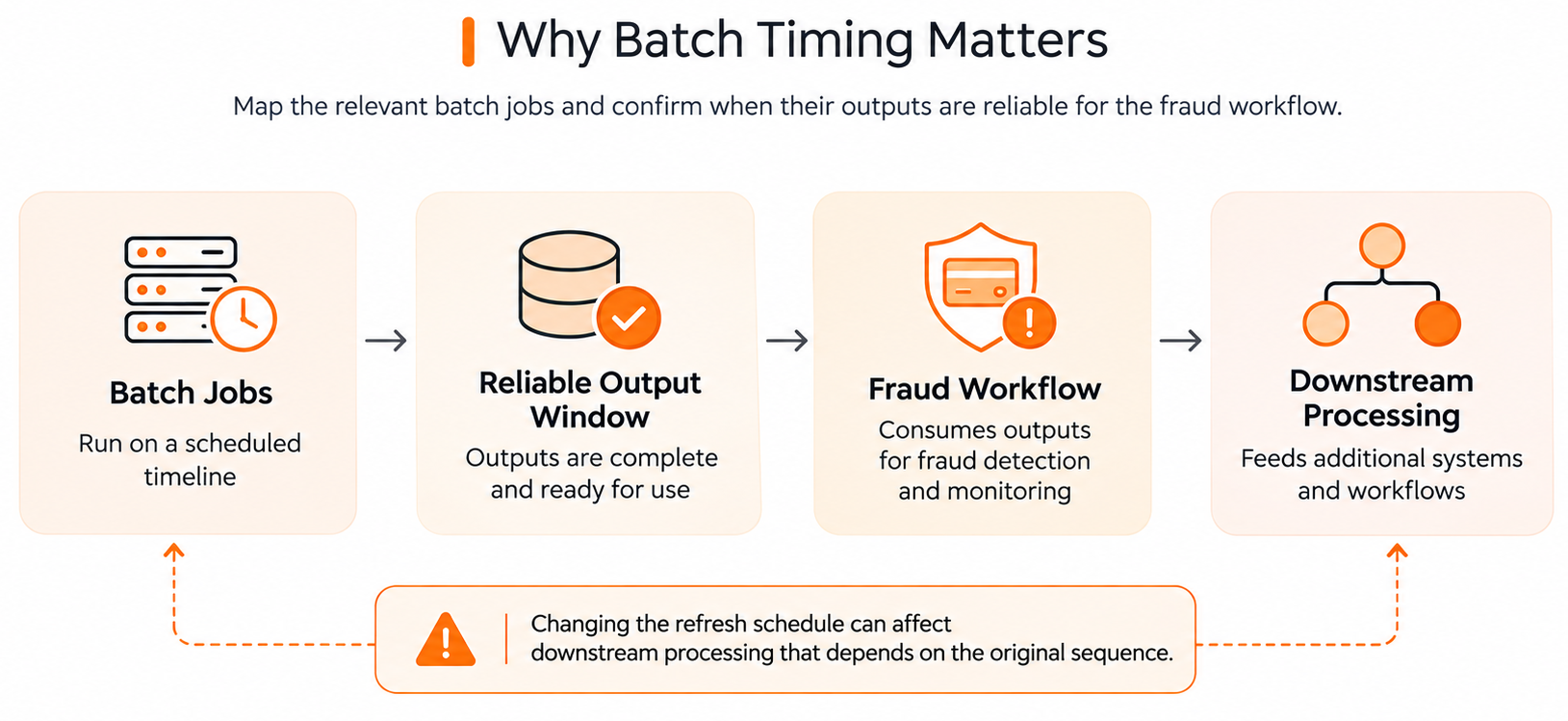
The cost grows when the feed fails. A missed account-data update can interrupt checks that a payment application performs before releasing funds. Support teams must identify the affected dependency, determine which transactions require attention, and handle exceptions until processing recovers.
If an incident record contains only the final fix, the next engineer must repeat the earlier investigation. That lost context adds diagnosis hours to a failure whose technical cause may already be known.
The recurring expense is measurable. Record how long the team spends identifying the root cause, how many payments require manual handling, and which downstream processes need recovery work.
Solution: Modernize the Payment Data Path and Retain Incident Context
Begin with application dependency mapping to identify the required account updates, their schedules, and the downstream checks that rely on them. Engineers can then change the affected feed, test transaction handling and reconciliation, and define fallback procedures before live deployment.
Within The Lifter, two modules address these challenges.
| When it applies | Recurring gap | Indium module |
| Before deployment | Undocumented batch schedules and downstream job dependencies | Legacy Lifter |
| After go-live | Incident findings and previous fixes scattered across tickets | AMS Lifter |
Legacy Lifter’s Job Dependency Mapper can surface scheduled jobs and their relationships before the team changes the data path. After deployment, AMS Lifter connects incidents with system dependencies and earlier resolutions, helping engineers avoid the same investigation on every recurrence.
AMS Lifter can also test its agentic capabilities against historical incidents before it receives live access. Engineers review those results, define where human approval is required, and expand autonomous actions only when the evidence supports it.
Problem 3: How Missing Data Lineage Raises AI Validation Costs
A risk model may depend on a financial field that passes through several transformations before it reaches the model. SAS programs, extract-transform-load (ETL) jobs, and warehouse logic can each change how that field is calculated. When teams do not document those steps, engineers must reconstruct the calculation during model validation or an investigation. The same discovery effort returns whenever the input or pipeline changes.
In its January 2026 newsletter on BCBS 239, the Basel Committee identified legacy systems and distributed data environments as obstacles to end-to-end data lineage. For bank risk teams, the practical cost is the time spent retracing and explaining model inputs that should already have a documented history.
Solution: Trace Transformations Before Modernizing the Data Path
Start with the model inputs that take the longest to validate. Data Lifter can analyze existing transformation logic and draft lineage records linking the resulting fields to their sources. Engineers and business owners then review those records to confirm the approved meaning of each input.
During migration, compare outputs from the existing and revised implementations and investigate unexplained differences before cutover. Retain the approved transformation evidence for subsequent model reviews. Track the effort required to validate the next change to see whether the documented lineage reduces repeat investigation.
Why the Same Technical Debt Keeps Costing You
In all three workflows, the expense is the repeated work of finding out what the legacy system does: tracing a rule, diagnosing a feed, rebuilding a calculation. A model can keep improving while the engineering and operations team keep absorbing that cost.
An AI ROI assessment needs to account for the full workflow, including the work required to keep its decisions running.
| Workflow | Recurring cost to measure | Business measure |
| Lending | Rule investigation and manual credit review | Manual-review rate and cost per completed application |
| Payment and fraud | Feed diagnosis and payment exception handling | Investigation hours, affected payments, and manual-handling cost |
| Risk analytics | Reconstructing transformations during model validation | Validation effort and elapsed time to approve a model-input change |
Calculate the Recurring Cost Before Funding a Fix
For one workflow, estimate the annual effort behind repeated investigations, manual exceptions, and repeat validation. Apply fully loaded labor rates to the actual hours recorded for each activity.
Estimated annual recurring labor cost = investigation cost + manual exception-handling cost + repeat validation cost.
Keep the categories separate so the same hours are not counted twice. Compare the avoidable portion of that cost with the one-time modernization expense and the ongoing cost of the revised workflow.
A business case for financial operations should distinguish reduced cash spending from capacity the institution can use elsewhere. Fewer engineering hours do not automatically become budget savings. Use the business measures above to confirm whether modernization reduces the cost of running the decision or increases capacity in a way the institution can demonstrate.
Find the legacy dependencies that are reducing your AI returns.
Modernize the Dependencies that Matter Most
Knowing where technical debt consumes AI returns leaves another important decision. How much of the existing system actually needs to change?
Replacing an entire application to address one AI workflow constraint can cost more than the problem itself. A short-term integration fix may be cheaper initially but leave the repeat investigation untouched.
The better starting point is to identify the part of the workflow responsible for the recurring cost. An outdated data interface may only need a targeted change. When embedded processing logic causes repeated investigation, engineers may need to modernize the affected component while preserving the business behavior that still works.
The real engineering challenge is deciding what to change without disturbing what the business already depends on.
The Lifter brings agentic AI into that assessment by recovering technical context from existing systems. Engineers can use the findings to define the modernization scope and understand how proposed changes affect dependent applications.
Before cutover, teams can compare outputs from the existing and modernized implementations. Business owners should review intentional changes to decision logic, while engineering teams investigate unexpected differences.
What Indium Does in Practice
Indium saw this pattern at a U.S. consumer credit provider with nearly $8 billion in banking assets. 2,500 SAS modules sat behind its credit decisions and regulatory analytics, and a shrinking pool of SAS specialists maintained them. Data Lifter documented the embedded business rules before any conversion began, then automated 70% of the code translation.
- Four parallel PODs worked through 34 tranches of modules.
- Conversion throughput reached approximately 20,000 lines of code per week, compared with approximately 6,500 through manual migration.
- Parallel runs of the SAS and Python versions confirmed matching outputs before production cutover.
The Lifter connects application understanding with the data engineering work required for modernization. Its Data Lifter module reads schemas and ETL code to draft lineage and catalog entries. Engineers validate those records, giving model reviewers evidence of how source data changes before it reaches the model.
Make the Next AI Investment Earn Its Expansion
At the next AI funding review, ask a harder question. Which recurring legacy cost will actually disappear when this use case scales? Name the workflow, the cost owner, and the measure that will show whether the burden decreases.
A stronger model can still be worth deploying, but its business case should not assume savings that the surrounding systems cannot deliver. Use the first targeted modernization result to decide whether the next expansion is justified.
Find the legacy dependencies that are reducing your AI returns. Discuss Your Modernization Priorities
FAQs about AI in Financial Services
Before AI implementation, financial institutions should assess existing business rules, application dependencies, data flows, and processing constraints that could affect AI performance.
Technical debt increases operating costs when outdated data feeds, undocumented dependencies, and recurring incidents force teams to repeat investigations or handle transactions manually.
Data lineage helps financial institutions trace AI model inputs to their sources, validate data transformations, and provide evidence during model reviews and regulatory examinations.
Financial institutions should measure recurring investigation, exception-handling, and validation costs, then prioritize modernization efforts that deliver measurable operational savings.

A champion of clear communication, Abinaya navigates the complexities of digital landscapes with a sharp mind and a storyteller’s heart. When she’s not strategizing the next big content campaign, you can find her exploring the latest tech trends, indulging in sports.