
Why Legacy Banking Systems Block AI Scaling
- November 27, 2026
- Posted by: Abinaya V
- Category: Data & AI

In banking and financial services, an AI model returns a score in milliseconds. The core banking system, which holds account records and enforces product rules, then decides whether anything changes in the account.
Scaling AI in banking is often limited by how well core systems act on a model’s output at the speed the workflow requires.
A pilot shows whether a model produces useful answers. Scaling the same capability across banking products raises a second question. Can existing applications act on the model’s output through approved workflows at normal transaction volumes? The answer often depends on integration points that predate the AI initiative.
Banks can target modernization more precisely once they identify the application dependencies that limit AI-assisted work. The sections below show where legacy architecture restricts AI scaling and how banks can choose and map the systems to modernize first.
Where Costs Appear When Banks Scale AI
Expanding an AI use case increases the work required around the model. A prepared pilot dataset gives way to live banking records, where product-specific rules determine which actions the application permits. Reusing the capability across products may also require separate integration and regression testing.
Model accuracy can improve even as operations teams continue to complete transactions through manual handoffs. Banking automation effectively ends at the recommendation stage. The cost shows up as added engineering work and longer release cycles. Banking leaders need to see which dependencies create the gap between model accuracy and completed transactions.
The table below maps each stage of expansion to the application’s needs and where the cost falls.
| When AI expands | What the application needs | Where the cost appears |
| From pilot extracts to live records | Access to current account and transaction information | Reconciliation work when records fall behind |
| From a recommendation to an action | Approved interfaces that preserve transaction controls | Manual steps to complete AI-assisted work |
| From one product to several | Mappings of business-rule differences across applications | Repeated integration and regression testing |
| From sandbox testing to routine use | A traceable link between the AI output and the record update | More work to reconstruct decisions across system logs |
Two measures locate the constraint. The first is the share of AI-assisted decisions that complete through authorized banking interfaces, tracked alongside model performance. The second is the number of manual steps each workflow still needs. Together, they show which application changes to prioritize before the next rollout.
Why Banking Infrastructure Is Becoming an AI Bottleneck
AI investment is reaching deeper into banking, while core applications still control when financial actions take effect. The gap becomes expensive when teams extend a use case beyond its original workflow.
In a November 2025 speech, Federal Reserve Governor Michael Barr said financial sector AI adoption appears concentrated on operational-efficiency tasks. He also noted significant investment in AI experiments for core functions such as credit decision support and fraud detection, and said firms need processes that stay consistent with applicable laws and risk management. Those core functions run on the applications that record and post transactions, which makes application readiness part of the risk conversation.
Legacy systems can schedule liquidity forecasting with overnight updates, while intraday account actions require fresher records. The architecture determines which AI workloads fit the existing processing model and which require changes.
The question for a CTO is where existing core applications restrict access to current information or controlled account changes.
Five Ways Legacy Systems Limit AI Scaling
A banking application can keep its original operating rules even after the AI layer improves. The integration work concentrates in five places engineers can inspect.
- Batch Jobs Delay the Data AI Needs
Batch jobs support established processing schedules, although AI workflows may need current information between those updates. Teams then add interim data feeds, introducing another integration path that requires reconciliation against the authoritative record.
A useful engineering signal is the record’s age at decision time. Record age exposes delayed updates that model response time hides. Interim feeds also need ordering rules, because delivery speed and confirmed account state can differ.
Fix: Set an acceptable data age and give AI access to current records from the system that owns them.
- Embedded Product Rules Expand the Change Scope
Deposit and servicing applications often enforce product-specific rules inside existing code. An AI recommendation still has to pass the same eligibility or account-state checks. Tightly coupled logic can turn a small interface change into a broader regression-testing exercise.
An API wrapper can expose existing logic while leaving the underlying coupling intact. Shared-code changes still require testing dependent workflows, so delivery follows the surrounding application’s release schedule.
Fix: Route AI actions through controlled interfaces and refactor the code an API wrapper would otherwise inherit.
- Fragmented Records Create Reconciliation Work
Customer identifiers can differ between servicing and analytics systems, while transaction status can change before final posting. Engineers have to identify which system provides the authoritative value for the action the AI workflow recommends.
Effective dates can also affect which balance a model receives after end-of-day processing. Production integration requires shared definitions that a carefully prepared pilot dataset may have obscured.
Fix: Name the core application that owns the authoritative record and reconcile against it.
- Hidden Dependencies Make Small Changes Risky
A customer-facing service may invoke shared programs or trigger downstream posting jobs. Engineering teams need to trace those effects before changing the path an AI-assisted workflow uses. An overlooked dependency can alter reconciliation or reporting in another application.
The critical question is which processes rely on shared business logic outside the target product. Such dependencies can force teams to coordinate changes around settlement windows or regression cycles.
Fix: Trace dependencies through source code and job definitions before changing the workflow’s path.
- Disconnected Logs Make Audit Trails Hard to Build
A model log can preserve the recommendation and the version that generated it. The core system holds the resulting transaction. A correlation identifier has to connect both records to any human approval.
Correlation becomes harder when services issue unrelated identifiers or post transactions asynchronously. The FFIEC’s August 2024 Development, Acquisition, and Maintenance booklet gives examiners guidance on assessing maintenance and change management. Banks that can trace AI-assisted actions and application changes can answer those examiner questions more easily.
In your application modernization planning, teams can trace dependencies backward from the completed banking action to identify the interfaces that deserve attention first.
Fix: Carry one correlation identifier from the recommendation through approval to the posted transaction.
Modernize the Banking Systems that AI Depends On
The modernization scope should follow the banking work an AI application needs to complete. Teams need dependable inputs before a decision and a controlled route for acting on the result. Three architectural changes deserve attention.
- Give AI reliable access to current banking data. Identify the core application that owns the authoritative record. Set an acceptable data age for the workflow, then verify timestamps and reconciliation. Confirm the latest account state before executing a balance-sensitive action.
- Put banking automation actions behind controlled interfaces. Route AI recommendations through an application interface that applies existing product rules and approvals. Make rejected or deferred requests explicit. Where a thin API wrapper inherits tightly coupled logic, plan targeted refactoring.
- Choose the modernization boundary deliberately. Keep a dependable core as the system of record while updating the services around it. Replace the core only when data freshness or verified transaction outcomes demand it, since those guide priority better than application age.
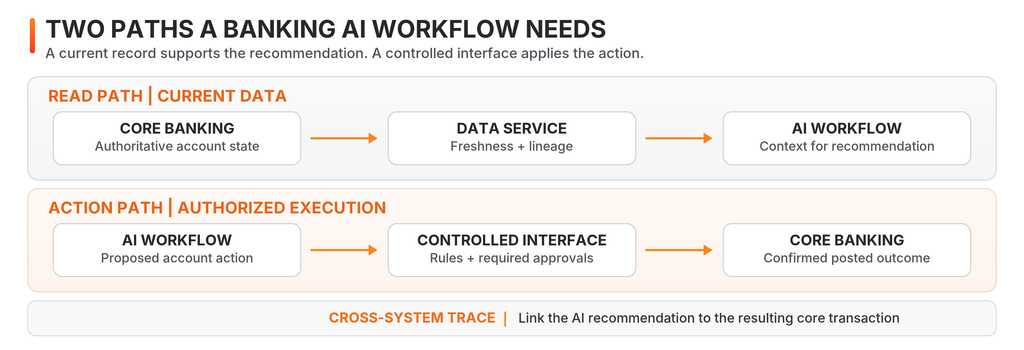
The two paths in the diagram require different checks. Data feeds provide current context; the action interface controls what the banking application can execute.
Understand the Existing System Before Modernizing It
The modernization boundary above depends on what the existing systems actually do. A clean interface can still hide complicated banking application behavior. Existing code decides what happens after a request reaches the core, including calls to shared programs and scheduled jobs that run later. Engineers need to trace those relationships before they separate a function from the core.
The practical test is whether the team can follow a proposed change from its entry point to the downstream records it affects. Source code and job definitions offer a firmer basis than inherited architecture diagrams alone. Findings from that trace also need engineering review before they shape the modernization scope.
The Lifter is Indium’s agentic AI platform for recovering technical knowledge from existing enterprise systems before modernization. Its agents examine engineering artifacts and organize the findings into traceable documentation that teams can inspect. Engineers review the resulting analysis before they approve specifications or make changes to banking applications.
Legacy Lifter Recovers the Rules Behind the Application
Within The Lifter, the Legacy Lifter module examines source code and traces dependencies that connect application modules with processing jobs. For a banking integration, that evidence helps define which existing behavior the new service interface needs to preserve.
Data Lifter Traces What Happens to Banking Data
The Data Lifter module, part of the agentic AI platform, examines database schemas and transformation code to map how records change as they move from source systems to downstream applications. It drafts lineage documentation and data quality rules, leaving engineers to validate the meaning of important fields. Banking teams can use that documentation to assess the information an AI workflow will consume. Indium applied Data Lifter to a SAS migration for a consumer credit provider.
AI Scaling Is Also an Application Modernization Decision
A bank can approve an AI initiative on the strength of its business case and still stall it at the first core system. AI spending and application modernization can move through separate approvals, so the engineering work that makes a model usable in daily operations competes for funding on its own.
The fix starts with the business case. Include the engineering work that connects the model to the core in the initiative’s budget, so the investment is judged on its full cost.
For banking CTOs, this link changes how modernization earns priority. Upgrading a legacy application creates value through the capabilities it makes possible, such as fresher data for a model or a controlled route for a banking action. Those capabilities give CTOs a stronger basis for deciding which projects come first.
Indium’s engineers can map the dependencies behind a bank’s first scaled AI workflow. Banking teams can talk to an Indium expert to begin that mapping.
FAQs about Legacy Systems
Pilots run on prepared data, while production adds live records and product rules that need integration and testing work.
RPA follows fixed rules to move data between systems. AI scores and recommends, so banking automation built on it needs an approved interface that lets the core act on the output.
Banks link the model log and the core transaction record, along with any human approval, using a correlation identifier.
Trace dependencies backward from the banking action the AI workflow must complete, then rank changes by the data freshness and verified outcomes it needs.

A champion of clear communication, Abinaya navigates the complexities of digital landscapes with a sharp mind and a storyteller’s heart. When she’s not strategizing the next big content campaign, you can find her exploring the latest tech trends, indulging in sports.