


Testing Microservices: Why End-to-End Quality Is Harder Than It Looks
- November 25, 2026
- Posted by: Muthu Kumar Dev
- Category: Quality Engineering

A lot of applications today are built as microservices, which makes microservices testing complex. There are dozens of small services, each handling a specific function and often owned by different teams. The services can all pass their individual tests but run into problems when they work together in real time, especially at the hand-off between them.
End-to-end testing seems like an obvious answer, but getting it right is harder than it looks. In the coming sections, you will see how AI can help with end-to-end testing and why the AI itself needs to be checked. One rule runs through all of it. AI assists, and fixed checks decide.
The Basics: Services, Journeys and Contracts
To understand end-to-end testing better, let’s start with a few key terms.
- Microservice: A small, independent piece of software that does one job, such as checking a customer’s identity.
- End-to-end test: A test that follows a full customer journey through every service involved.
- Contract: The agreement between two services about how they communicate and what each service expects from the other.
A loan application is a good example of this.
- Customer clicks Submit
- Identity service confirms the customer’s identity
- Credit service pulls the customer’s credit score
- Lending service applies the lending rules
- Document service stores the required documents
- Notification service sends the confirmation email
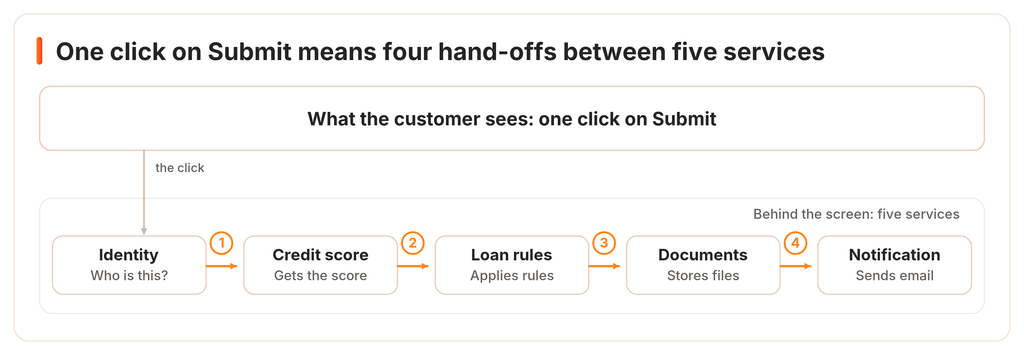
Every numbered arrow marks a hand-off, and any hand-off can break the journey. Microservices testing becomes harder at these points for four reasons.
- Keeping the Test Environment Ready Is Difficult
Each service has to be running at the right version and at the same time. When teams share an environment, their testing can interfere with one another.
- Test Data Is Spread Out
Services keep their own data individually. Creating one realistic test customer means setting up records in several places, in the right order.
- Timing Is Unpredictable
Some steps happen in the background a few seconds later. A test that checks too early fails even though nothing is wrong.
- Nobody Owns the Gaps
When a journey fails, time is lost working out which team should look at it.
This can leave test suites slow and prone to unexplained failures. Testers call such tests flaky.
The Role of AI in End-to-End Testing
The number one rule to keep in mind is to let AI draft, summarize, and suggest, but keep the final pass or fail decision with fixed, repeatable checks. This is an important part of AI testing, where AI is used to support the testing process without becoming the final judge.
A check that gives a different answer on each run cannot be trusted to approve a release.
Much of the difficulty in end-to-end testing comes from volume. There are more service agreements, log files, and data combinations than people can read. Large language models (LLMs), the technology behind AI assistants, read large amounts of text quickly, which makes them a practical fit for five common problems.
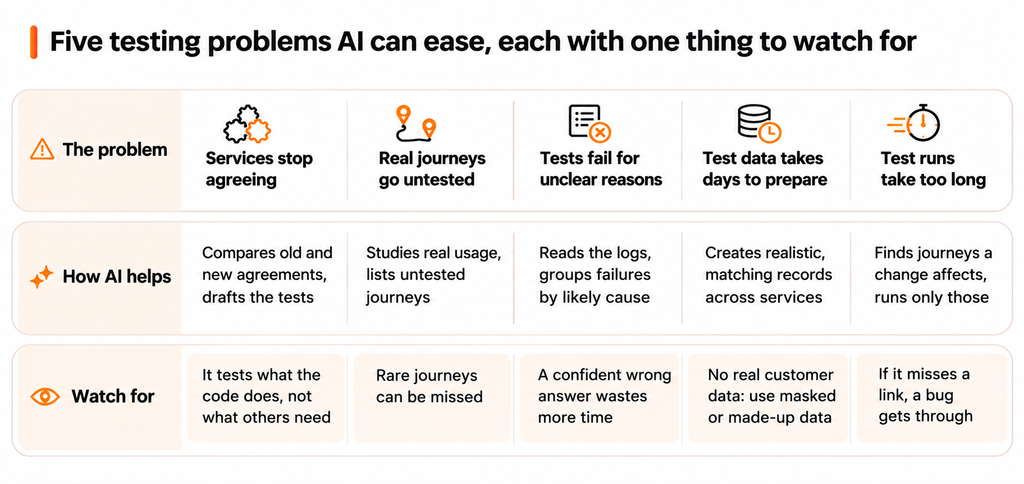
Let’s look at each of these five areas and see where AI can help.
Keeping Services in Agreement
A contract test checks a service against the agreement it shares with dependent services. Since the test runs on the service itself, it is quick to run and can catch hand-off problems early. The downside is the effort involved in writing them, so teams often have too few. AI can help in two ways.
- It can compare old and new service specifications to flag breaking changes before release, known as spec diffing.
- Another use is drafting consumer-driven contract tests from the receiving service’s expectations.
Learning from Real Usage
Open tracing standards let services record the path each request takes through the system. These records, called traces, can help AI identify the customer journeys happening in production and compare them with the test suite.
In the loan example, this could reveal that customers regularly add a co-applicant after the credit check, even though no test covers the journey. Since tracing may capture only a sample of requests, rare journeys can still be missed, so the results should not be treated as complete.
Sorting Failures Faster
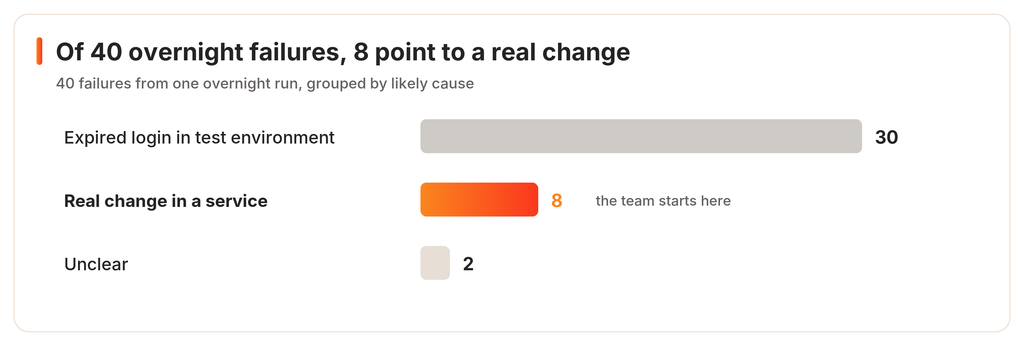
An overnight test run reports forty failures, but they can come from only a few causes. AI can read the logs and error messages and group the failures by likely cause.
Thirty come from an expired test-environment login, eight from a real service change, and two remain unclear. The team can focus on the eight first. Fixing the expired login clears most of the failures, so the team can focus on the eight real ones first. Spot-check the groupings. A confident wrong diagnosis can waste more time than no answer.
Preparing Test Data
Creating realistic, matching test records across several services is slow work. AI can generate them from each service’s data rules. Use masked or made-up data for this, never real customer records.
Shortening Test Runs
AI can identify the journeys a code change could affect and run only the relevant tests, giving the team faster feedback. Run the full test suite on a schedule as a safety net. AI can miss a dependency affected by the change, and that missed test can allow a bug through.
CTA –
Test connected services with more confidence.
Letting AI Agents Explore Untested Journeys
AI agents can explore journeys nobody thought to script, which makes them useful for finding unexpected issues in a safe test environment. They are less suited to routine release checks because they can take a different route each time they run.
Protect Customer Data Throughout
Logs and traces often contain names, account numbers and other personal details. Mask or remove that data before any of it reaches an AI tool, and check where the tool stores what it receives. Data protection and privacy laws apply to personal data across many sectors, not just banking.
Healthcare, insurance, retail, telecom, government, and technology companies can all have obligations depending on the jurisdiction and type of data they process.
Evaluating AI for Testing
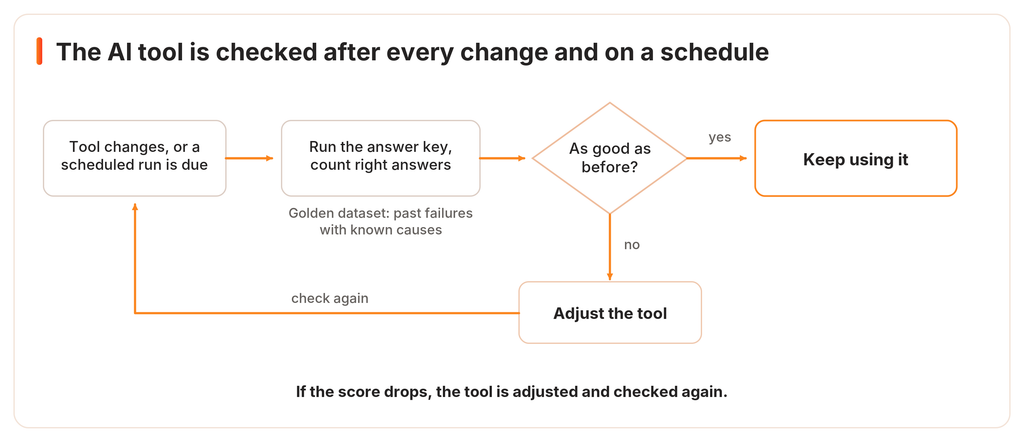
AI testing comes with its own risks. AI tools make mistakes too. Once AI is part of testing, it becomes one more thing that has to be tested. This is called AI evaluation, and it comes down to three questions: is the AI right, is it consistent, and would we notice if it got worse?
Four checks can help answer those questions.
- Keep an Answer Key
Start with 50 to 100 past failures where the real cause is known. Add new examples over time to build a golden dataset. Run the AI against it whenever the tool or its instructions change, and regularly check it as hosted AI models can change over time.
- Measure Results
Writing a thousand tests does not help if they catch no bugs. Add deliberate bugs to the code and measure how many the tests find. This is called mutation testing.
- Check for Consistency
Give the AI the same input several times and see how often it gives the same answer. Set a minimum level of agreement for each task. If the results vary too much, narrow the task or add human review.
- Keep People Involved
In regulated areas such as banking, AI can suggest a test for an interest calculation. An accountable person should confirm the expected result before the test is accepted.
What Your Team Can Take Away from This
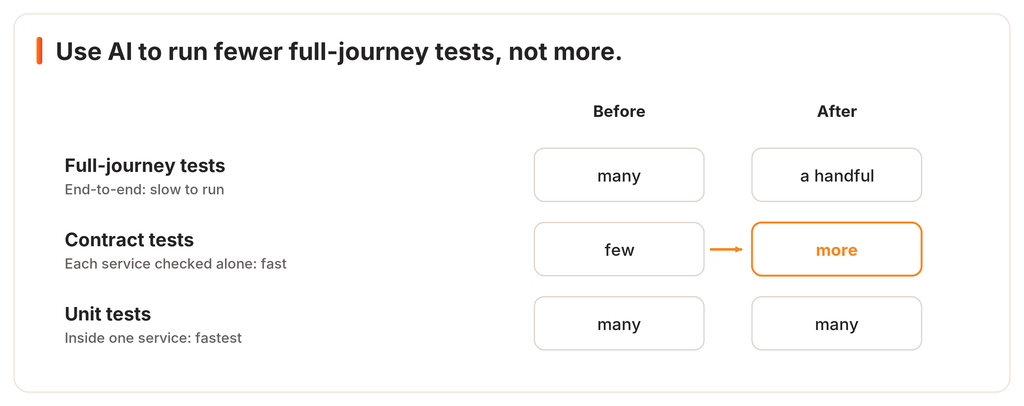
End-to-end quality is hard because the problems sit in the hand-offs between services, where no single team is looking. More full-journey tests will not solve the problem. Strong service agreements and a few trusted journey tests are a better approach.
AI speeds up whatever is already there. If services have no clear contracts and no monitoring, AI will produce many tests that look convincing and check very little. Get those foundations in place first. Do not use AI to pile on more end-to-end tests.
Use it to need fewer. Catch problems earlier with contract tests, which check each service on its own and run quickly. Keep a handful of full journeys to confirm everything is connected.
CTA –
Still testing more to find less?
Rethinking Quality in the Age of AI
End-to-end testing has always been about proving that a system works as a whole. With AI entering the process, the bigger question is what happens to the way teams approach quality. If AI takes over more of the work, testers will spend less time simply creating and running tests and more time deciding what good testing looks like. It changes the skills that are being demanded in the industry today.
Understanding how a system should behave is no longer enough. You need to know when an AI-generated answer is trustworthy and when it needs to be challenged. Start thinking about how much better we can make testing when we know where to trust AI and where to keep a human in the loop.
