
2027 Predictions: AI in Data, Analytics, App Engineering and Quality Engineering
- November 27, 2026
- Posted by: Vaibhavi Tamizhkumaran
- Category: Data & AI

2027: the year AI is held to account
Enterprise AI has moved from experimentation to expectation. After two years of rapid adoption, boards and executive teams are asking a harder question: where is the measurable return? In 2027, that question will shape budgets, roadmaps and vendor decisions.
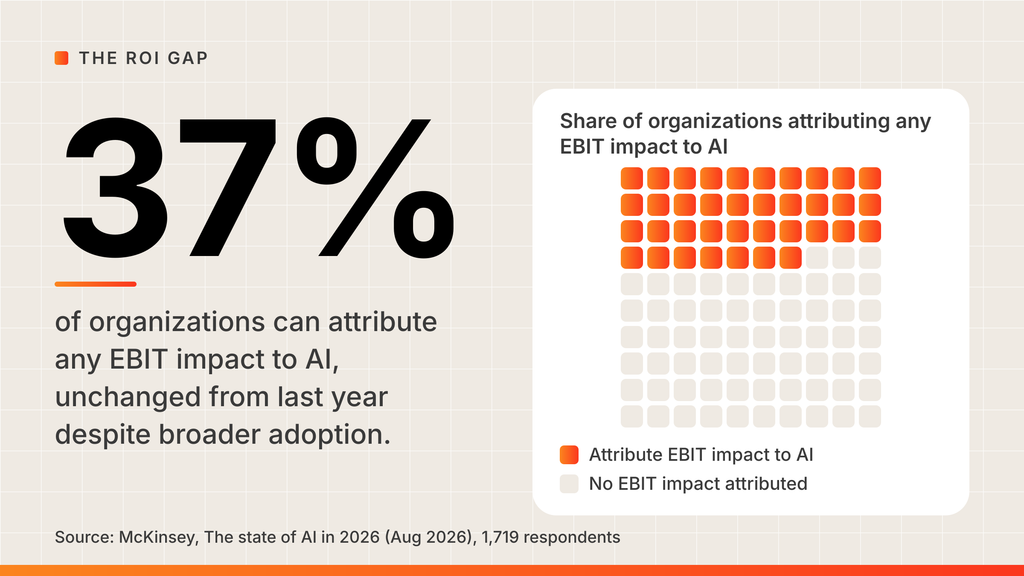
Many organizations cannot yet answer it. McKinsey’s 2026 State of AI shows adoption continuing to climb, while the share of organizations able to tie any earnings impact to AI has barely moved from the previous year.
The implication is that 2027 will be defined less by larger models and more by operational discipline across four fields: data, analytics, app engineering and quality engineering. This article sets out what is likely to change in each, and what leadership teams should do now.
Data: context engineering makes data AI-ready
Prediction: in 2027, “AI-ready” replaces “big” as the attribute that matters most in enterprise data.
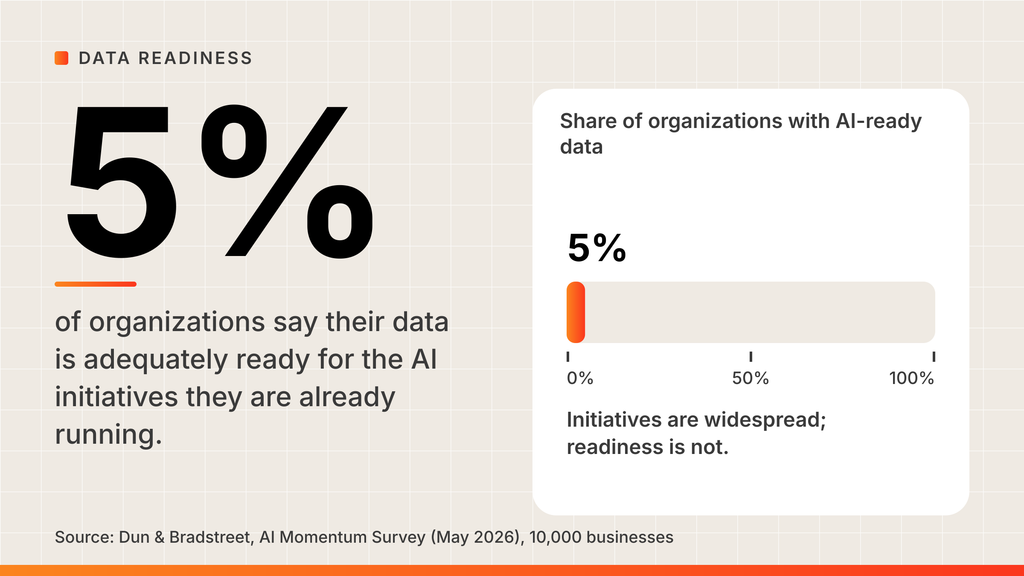
The gap between ambition and readiness is wide. Dun & Bradstreet’s AI Momentum Survey finds that almost every organization now runs active AI initiatives, yet very few consider their data adequately prepared to support them. Initiatives rarely stall because the model is weak. They stall because the underlying data is inconsistent, ungoverned or poorly understood.
Three shifts follow. Data products with named owners, freshness guarantees and quality contracts will replace ad hoc, person-dependent datasets. Semantic layers will become shared infrastructure, because AI agents need business meaning, not just tables. And data teams will spend less effort moving data and more effort curating context.
Next step: select the two or three AI use cases that matter most, trace every data element they depend on back to its source, and remediate those pipelines first.
Build connected ecosystems
Analytics: from dashboards to decisions
Prediction: the central question shifts from “what happened?” to “what should we do, and who decided?”
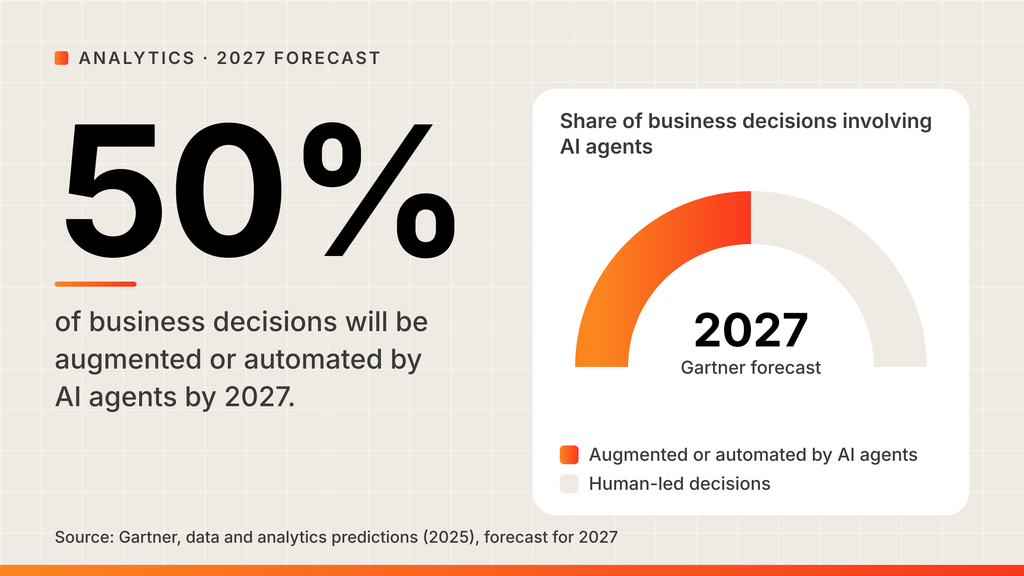
Gartner expects AI agents to augment or automate a significant share of business decisions by 2027, with static dashboards giving way to decision-ready narratives. In practice, analytics platforms will proactively surface what changed, why it changed and what action is recommended.
Trust is the constraint. Stack Overflow’s 2026 survey shows that technology professionals remain cautious about relying on AI for consequential decisions unless they can verify the output. That should be treated as a design requirement: expose sources, make reasoning inspectable, and keep human approval on high-stakes calls. Gartner also cautions that agentic analytics without a consistent semantic layer is likely to fail.
Next step: retire dashboards that no longer inform decisions, and measure analytics by decision speed and decision quality rather than report volume.
App engineering: from writing code to orchestrating it
Prediction: writing code stops being the bottleneck, and everything around it becomes one.
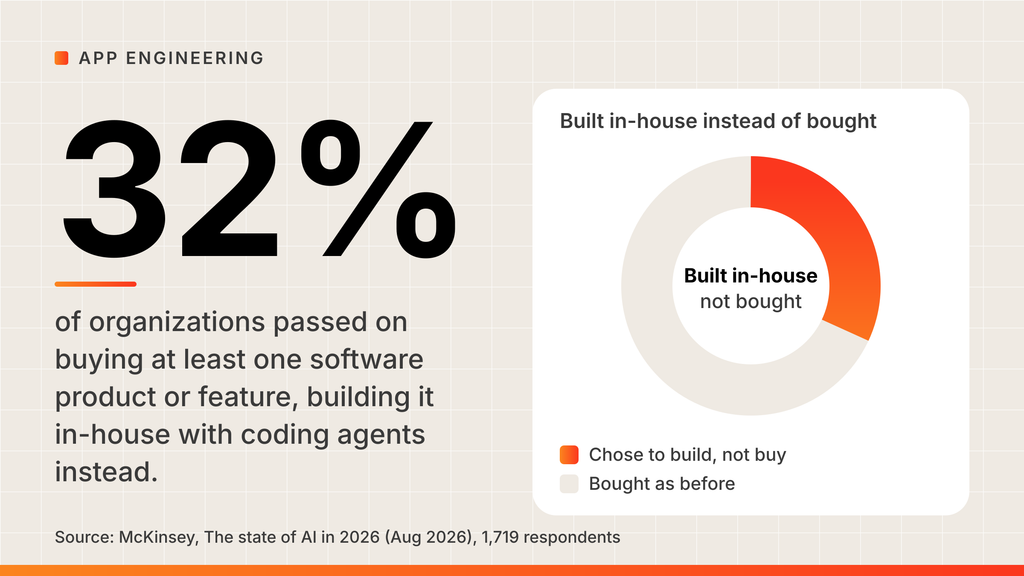
Coding agents are rewriting build-versus-buy economics. McKinsey reports that a meaningful share of organizations have already chosen not to purchase a software product or feature because they built it in-house with coding agents. Developer adoption is moving faster than organizational policy: most employers have yet to publish approved tools or formal AI guidance.
More code means more review, more testing and more systems to maintain. DORA’s 2026 ROI report describes a J-curve: productivity dips first, driven by a “verification tax” on checking AI-generated code, before the gains arrive. Throughput that stalls in a review queue is not throughput.
Expect 2027 to reward platform engineering, small change sets, strong automated test suites and well-documented architecture. AI amplifies whatever an engineering system already is.
Next step: measure the whole delivery flow (lead time, review time, change failure rate), not only code output.
Modern times call for modernized applications.
Quality engineering: trust becomes the product
Prediction: quality engineering moves from the end of the pipeline to the center of the AI strategy.
The evidence is uncomfortable. Tricentis’s 2026 survey finds that many organizations still deploy untested code, and the reasons have shifted from oversight to choice: pressure to prioritize speed, and AI-generated code volumes too large to test fully. Senior executives are also notably more confident in AI-driven systems than the QA and DevOps professionals who run them. The people closest to the releases are the least convinced.
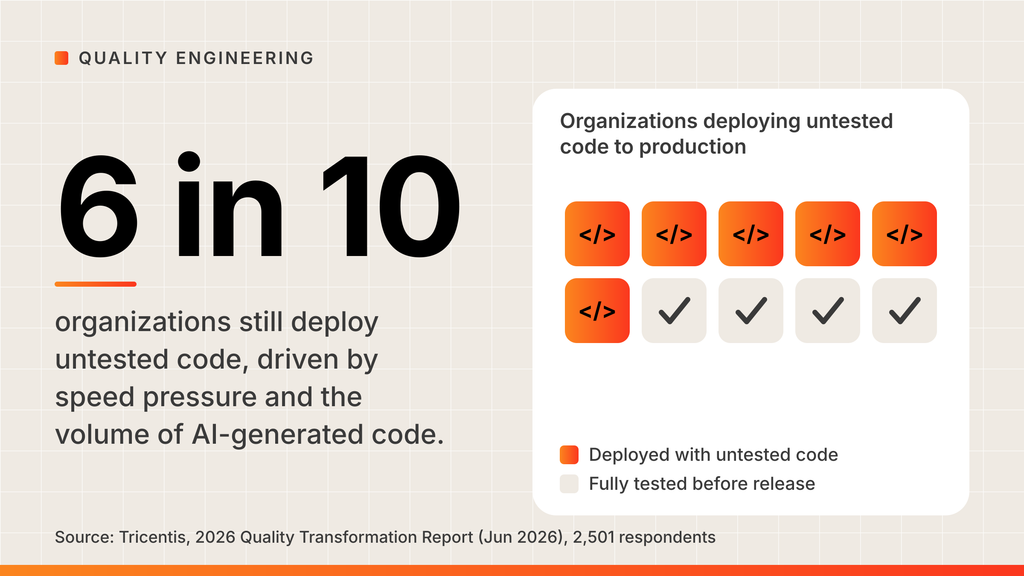
The World Quality Report 2025-26 tells a similar story: most organizations are pursuing GenAI in quality engineering, but few have scaled it across the enterprise.
In 2027, QE teams will carry two mandates. AI for quality means using agents to generate tests, heal brittle scripts and prioritize risk. Quality for AI means testing the agents themselves: evaluation suites, guardrail checks, regression tests for model and prompt changes, and human approval gates before anything autonomous reaches production.
Next step: budget the two as separate workstreams and give leadership a single quality-risk indicator with every release.
What organizations must do next
Invest in foundations before features. McKinsey’s high performers allocate a larger share of their technology budget to AI and plan to raise it further. The spend extends beyond models: data readiness, evaluation and test infrastructure, platform engineering, and cost controls that keep consumption-based AI costs predictable.
Operate agents like members of the workforce, not experiments. Every agent needs an owner, a defined scope, monitoring, an audit trail, and an off switch. Capgemini finds that banks and insurers are already creating roles to supervise AI agents. Agent operations will become as established a discipline as DevOps.
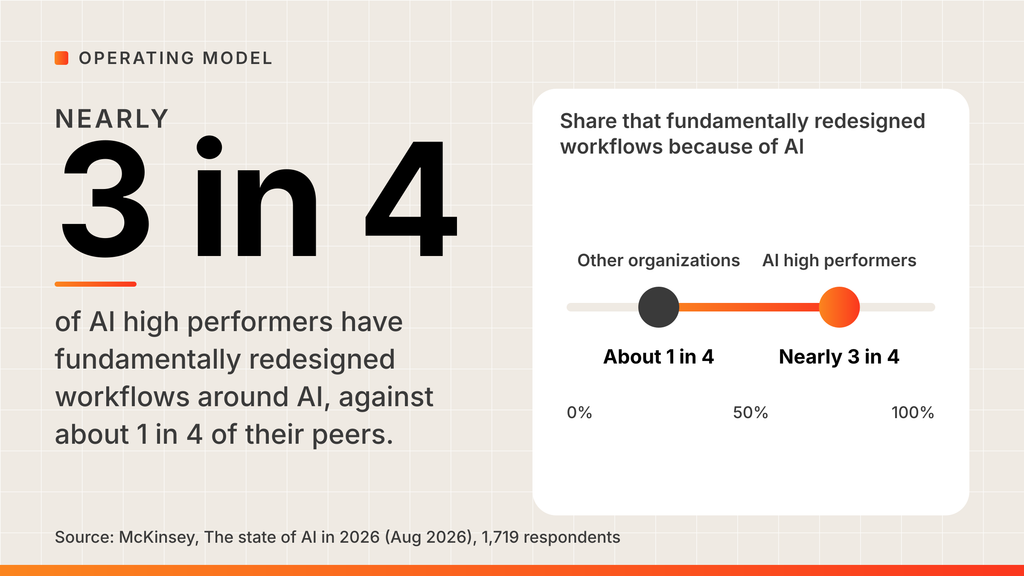
Redesign the workflow, then add AI. High performers are far more likely than their peers to have fundamentally redesigned workflows around AI. Adding a copilot to a broken process only makes the broken process faster.
Cut early, scale the winners. Gartner advises pursuing agentic AI only where the value is clear. Set a 90-day gate: if a pilot cannot beat its baseline, retire it and reallocate the budget.
Tracking ROI with rigor
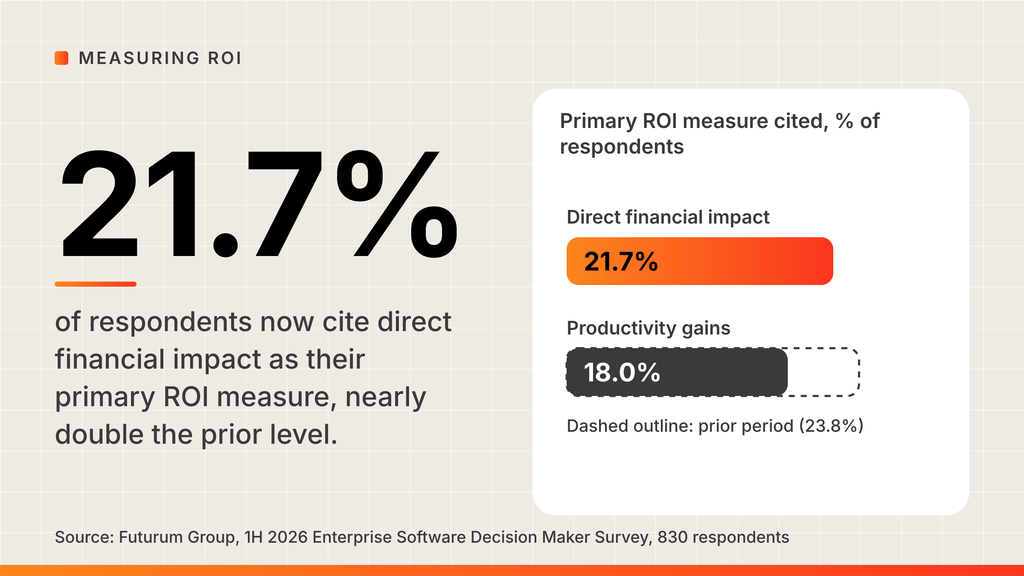
Finance leaders are moving beyond “hours saved” as the measure of success. Futurum’s 1H 2026 survey shows direct financial impact gaining sharply as the primary ROI measure, while productivity gains lose ground. McKinsey adds that high performers are far more likely to have defined processes for measuring AI impact.
Set the baseline before launch, then track four layers:
| Layer | What to track |
| Adoption | Active users, tasks handled by agents, human override rate |
| Workflow | Cycle time, rework, review-queue time, deployment frequency |
| Quality and risk | Change failure rate, escaped defects, incidents, compliance exceptions |
| Financial | Revenue influenced, cost-to-serve, and full cost: licenses, tokens, review effort, support |
Two cautions. First, plan for the J-curve: DORA’s ROI model assumes productivity dips before it climbs. Second, account for the full cost. A growing share of organizations already limit AI use because of operating costs, tokens included. Real ROI is what remains after review, rework and the invoice, not what the demo saved.
2027 by industry
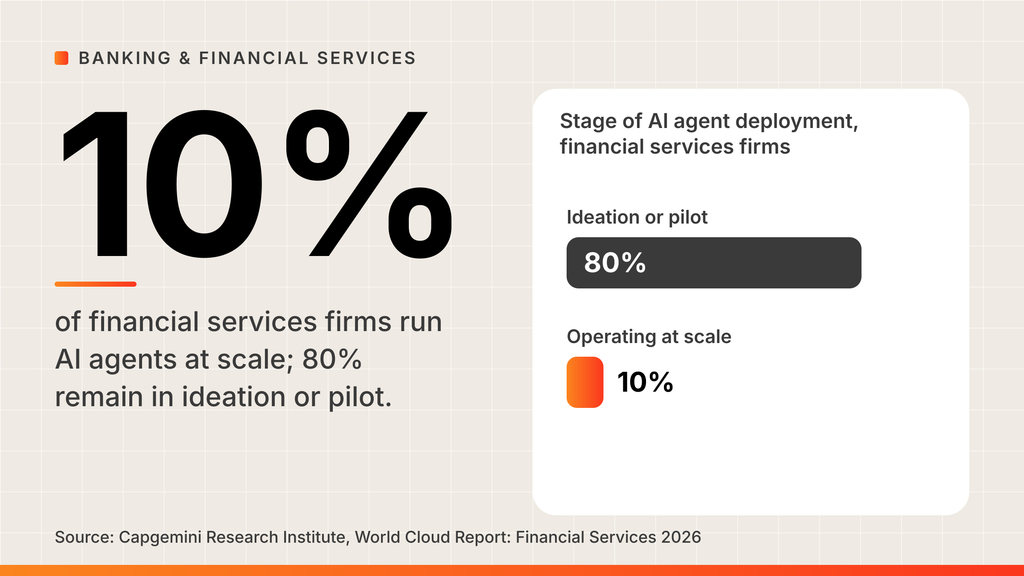
Banking and financial services: from pilots to supervised production. Capgemini’s research shows that only a small share of financial services firms operate AI agents at scale; most remain in ideation or pilot. McKinsey finds banks, insurers and pharma among the most likely to raise AI investment, so 2027 will be about governance: audit trails, explainability and human sign-off. Quality pressure bites hardest here too: financial services reported the highest rate of shipping untested code in the Tricentis survey.
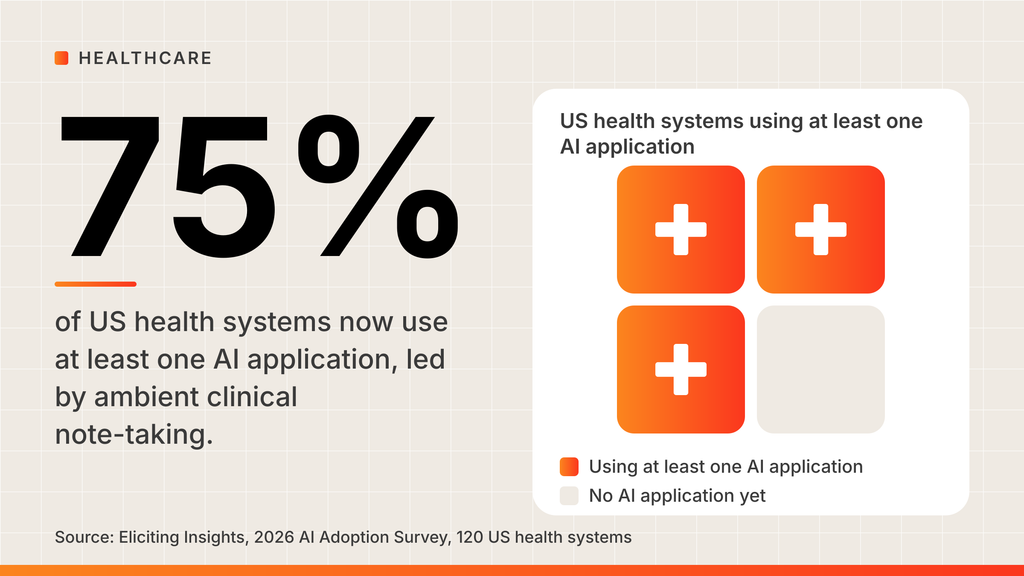
Healthcare: documentation first, then everything else. Eliciting Insights reports broad adoption across US health systems, led by ambient clinical documentation, with many already seeing solid returns. Expect growth in coding, denials management and patient communication, with accuracy, reliability and bias as the gating concerns, per L.E.K.
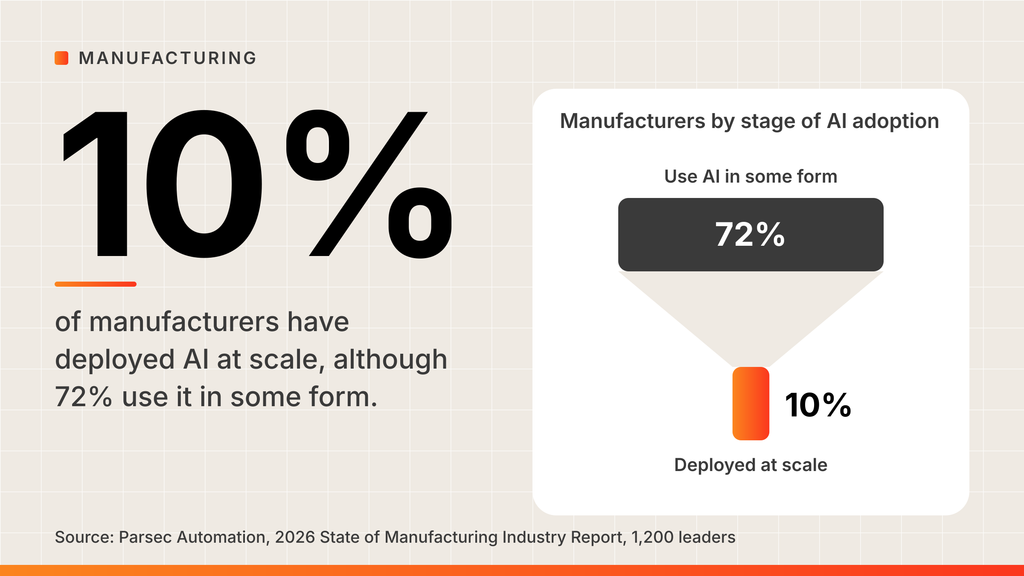
Manufacturing: from predictive to autonomous. Parsec’s survey of manufacturing leaders shows that most use AI in some form, yet few have deployed it at scale. Predictive maintenance remains the leading use case. The 2027 agenda is data integration across legacy and modern equipment, followed by physical AI.
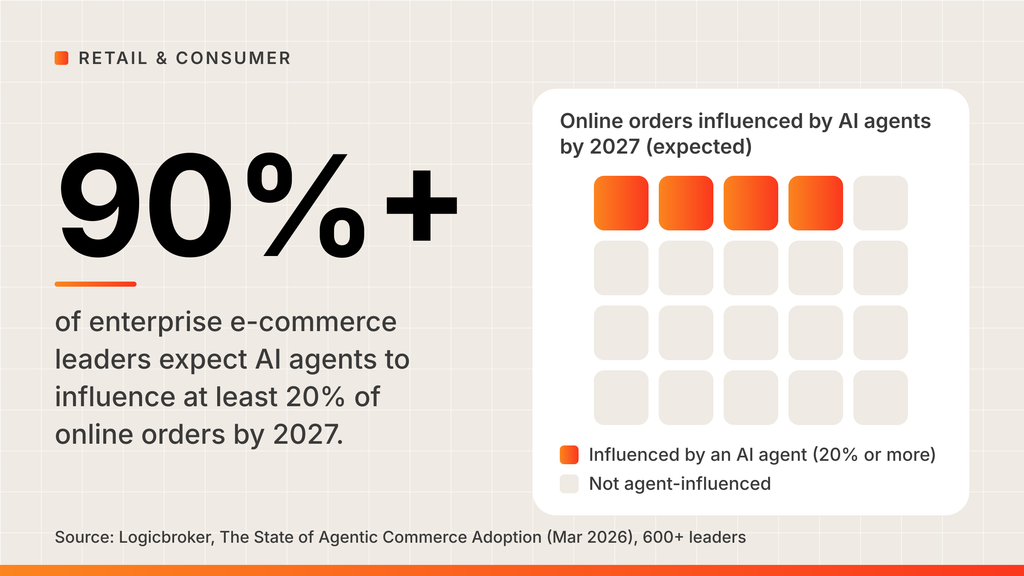
Retail and consumer: serving the customer’s agent. Logicbroker’s survey shows that enterprise e-commerce leaders overwhelmingly expect AI agents to influence a meaningful share of online orders by 2027. Clean product data, accurate inventory and open APIs will become the new storefront.
Tips for 2027
- Start with the decision, not the model. Name the decision, its owner and the baseline metric before building anything.
- Fix the data first. Remediate the pipelines your top use cases depend on before buying new tools.
- Shrink pull requests and pilots. Small changes get reviewed, and reviewed changes ship.
- Involve QA early. Give quality engineers a seat in architecture and AI design reviews.
- Publish an AI usage policy. Most employers have yet to do so.
- Train for verification. The scarce skill is judging AI output, not generating it.
Challenges 2027 will face
- Cost volatility. A growing number of organizations already limit AI use because of operating and token costs, and agent fleets will push this further.
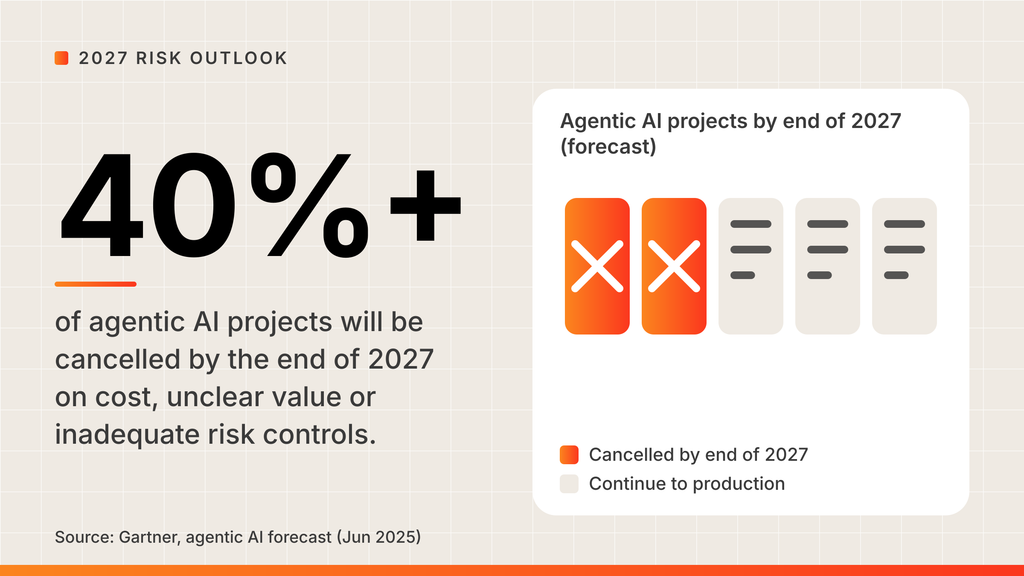
- Agent washing and cancellations. Gartner expects a large share of agentic AI projects to be cancelled by the end of 2027, partly because many vendors rebrand chatbots as agents. Ask for production references, not demos.
- The confidence gap. Senior executives are markedly more confident in AI-driven systems than the QA and DevOps teams who run them. Close the gap with shared metrics, not slogans.
- Governance lag. Adoption is outpacing policy, and every unowned agent is a latent incident.
- People strain. Mid-level managers and individual contributors report more negative AI-related effects than executives do, and expectations of job cuts have so far outrun reality. Leaders should be transparent about how roles will change.
Conclusion: show the work
Reinvention is a word used often, but in 2027 its meaning is simple: rethinking how work actually gets done. The value of AI will come from reinventing processes around it, not from adding it to the ones that already exist. That means applying AI where it can genuinely change the outcome, and leaving it out where it cannot, rather than using it for its own sake.
Get started on your AI jouney
Ambient clinical documentation shows the difference. Instead of adding AI to the routine of typing notes after each patient visit, health systems redesigned the step itself: the note is drafted while the conversation happens, and the clinician reviews and signs it. AI does what it is good at, listening and summarizing, and people do what only they can do. It has become one of the most widely adopted AI applications across US health systems, and many already report solid returns.
The leaders of 2027 will not be the organizations with the most AI. They will be the ones that can demonstrate results: ready data, accountable decisions, reviewed code, tested agents and an ROI figure the finance function trusts. It is less glamorous than a demo. It is also what turns a promising period of experimentation into a durable business capability.

Vaibhavi Tamizhkumaran is a marketer who writes about AI trends and their real impact, and moonlights as a food critic known for her wit and honest high standards. Whether it’s a new tool or a new tasting menu, she tries it, judges it fairly, and is always ready for a good conversation about what’s next.